
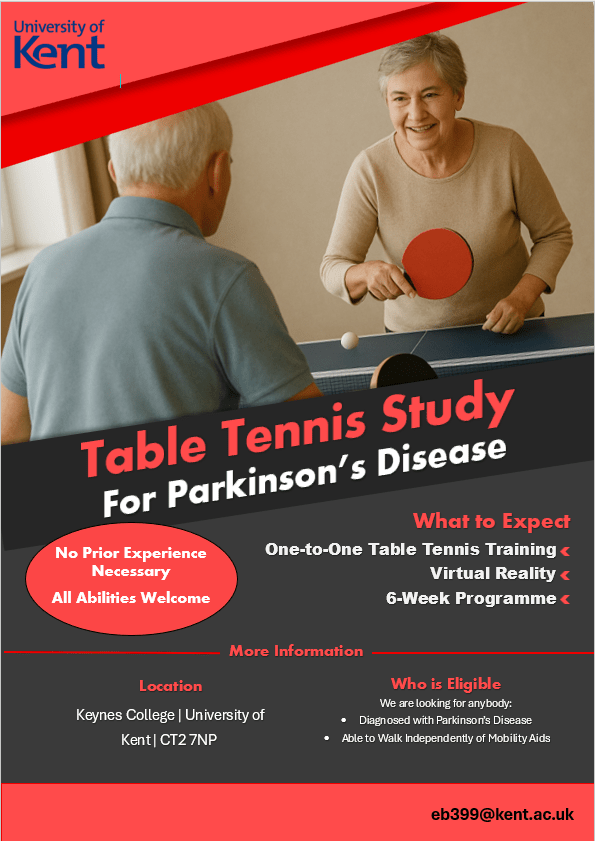
Comparing the Effect of Virtual Reality and Real-Life Table Tennis
The aim of the study is to compare the influence of virtual reality (VR) and real-life table tennis on Parkinson’s Disease symptoms across a 6-week training period. Please note that previous experience is not required; all abilities are welcome.
What Does Participation Involve?
If you choose to participate in this study, you will be randomly assigned to one of three training interventions.
Real-life table tennis;
VR table tennis;
Delayed treatment control.
Those assigned to the real-life and VR conditions will attend two, 60-minute table tennis sessions each week, for a 6-week period. Within these sessions, you will complete a series of table tennis drills (i.e., returning the ball from a ball machine or rallying with an opponent). Those assigned to the delayed treatment control will be given the option to complete either the real-life or VR training after the 6-week period has finished.
All participants will attend assessments at Week 0, Week 3, and Week 6 of the intervention period. During these sessions, you will complete a number of simple functional, balance, and aerobic assessments, and will be assessed on your table tennis ability.
Who Can Take Part?
People with Parkinson’s Disease;
With a Hoehn-Yahr score of 3 or below (Assessed by researcher during baseline visit);
With a low falls-risk (Assessed by researcher during baseline visit);
Free from any contagious eye infection for 2 weeks prior to commencement;
Free from any respiratory infection or injury for 2 weeks prior to commencement;
Able to walk independently without mobility aids (i.e., wheelchair, walker).
When Will the Study Take Place?
The study will be running from April to June.
Location
All visits will take place within Keynes College, opposite the Parkinson’s Centre at Tanglewood (University of Kent, CT2 7NP).
Contact
Researcher: Edward Baker
Email: eb399@kent.ac.uk

SPACE To BE: Living Well with Parkinson’s
Community engagement to find out people’s views about a proposed yoga therapy programme ‘SPACE To BE’ for people with Parkinson’s, and to discuss design aspects of a research study to evaluate the programme. We will seek people’s views on the content of the yoga therapy programme, the topics covered, the timing of the sessions, the number of sessions, the length of sessions, and how the sessions are delivered. We will also ask about possible barriers to participation, and how we may be able to overcome these. We will ask about what is most important to measure in the evaluation. There will also be an opportunity to experience a yoga therapy practice and provide feedback.
What Does Participation Involve?
Participation will involve a one-hour meeting in June or July 2026.
Who Can Take Part?
You can take part if you:
• Have a confirmed diagnosis of Parkinson’s disease.
• Are aged 18 or over.
When Will the Study Take Place?
June – July 2026
Location
Parkinson’s Centre for Integrated Therapy (PCIT), Canterbury
Contact
Researcher:
Tracy Pellatt-Higgins
Email: t.pellatt-higgins@kent.ac.uk
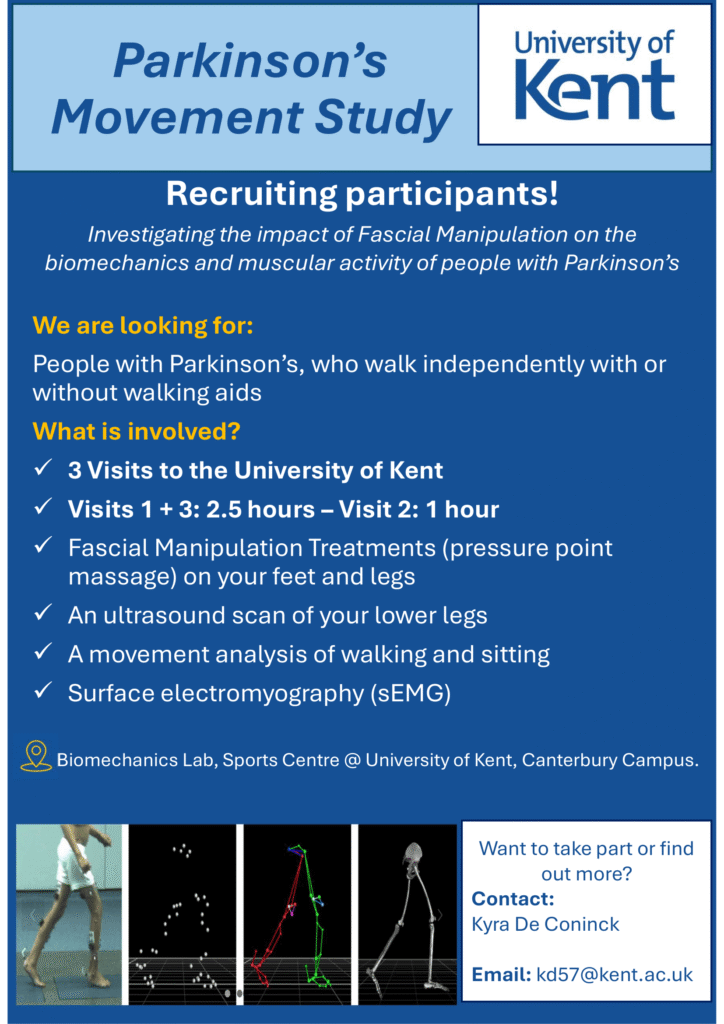
Fascial Manipulation for Movement in Parkinson’s
We are carrying out a research study to explore whether Fascial Manipulation, a hands-on treatment targeting specific points in the tissues around the muscles, can influence movement and walking in people with Parkinson’s. We will look at changes in walking, muscle activity and the muscles of the lower leg before and after 3 treatments.
What Does Participation Involve?
• A 90-minute interview.
• Attending 3 visits to the Biomechanics Lab at the University of Kent’s Sports Centre
Visit 1 + 3: 2.5 hours – A movement analysis of you walking across the room, getting up from a chair, and standing still. We will analyse your movement with 3D cameras before and after a Fascial Manipulation treatment.
Visit 2: 45 mins – Fascial manipulation treatment.
Who Can Take Part?
People with Parkinson’s who walk with or without walking aids.
• Aged 18+
• Able to attend the Biomechanics Lab at the Sport Centre, University of Kent, Canterbury
When Will the Study Take Place?
August – December 2026
Location
The Biomechanics Lab, Sport Centre, University of Kent, Canterbury
Contact
Researcher: Dr Kyra De Coninck
Email address: kd57@kent.ac.uk